Indexing
When you need a clear, useful index that helps readers navigate your book.
What Is Book Indexing?
A professional book index does more than list words and page numbers. It creates a structured guide to the concepts, names, subjects, and recurring themes readers are most likely to look for, helping them find relevant information quickly and understand how ideas connect across the book.
Our book indexing services are designed for academic and nonfiction books, including scholarly monographs, edited volumes, professional handbooks, and trade nonfiction. We work from final page proofs whenever possible so that every entry points readers to the correct page.
A professional book indexer reads the book closely, identifies meaningful concepts and terminology, and organizes entries and subentries into a clear, logical structure. Depending on the project, the index may include:
- Main subject and concept entries
- Names, organizations, and places
- Subentries for complex or recurring topics
- Cross-references between related terms
- Consistent terminology and alphabetization
- Accurate page references
For academic book indexing, we pay particular attention to specialized terminology, arguments, key concepts, and the ways readers and researchers are likely to approach the material. For nonfiction books, the same principles apply: the goal is to create an index that reflects the content and makes the finished book easier to use.
Indexing typically takes place near the end of production, once the book has been edited and typeset and page numbers are stable. The result is a carefully constructed back-of-book index that supports readers long after publication.
Who Benefits From Book Indexing?
Professional book indexing is most useful for nonfiction and academic books that readers will return to for specific concepts, names, arguments, or information. A well-constructed index makes complex material easier to navigate and increases the book’s usefulness as a long-term reference.
Scholarly monographs, edited volumes, handbooks, and other academic books benefit from indexes that capture specialized terminology, key concepts, names, and arguments in ways researchers can easily navigate.
History, biography, politics, business, cultural criticism, and other nonfiction books often contain people, places, events, and recurring subjects readers may want to locate after their initial read.
Publishers & University Presses
Publishers can bring us in during the final stages of production to create a professional back-of-book index from typeset page proofs, with the index delivered in the required format for production.
Museums, Businesses & Nonprofits
Museums, nonprofits, professional associations, research organizations, and other institutions may need indexing for substantial reference publications, handbooks, catalogues, and other information-rich books.
When Should You Get Book Indexing?
Book indexing typically takes place near the end of the publishing process, after your manuscript has been fully edited, designed, and typeset. Ideally, your indexer should work from final page proofs so that page numbers are stable and each index entry can point readers to the correct location.
You’re ready for indexing when:
- Your manuscript has completed editing and revisions
- The book has been designed and typeset
- You have final or near-final page proofs
- Page numbers are unlikely to change significantly
- Your publisher or production team has established an indexing deadline
Editorial workflow: Copyediting → Proofreading / Indexing
Some publishers may request an index created from a final Word document, but page proofs are strongly preferred whenever possible. Starting too early can require substantial revisions to the index if pagination changes later.
Indexing is often one of the last steps before a book goes to press, so it’s important to build enough time for indexing—and any resulting corrections—into your production schedule.
How Our Book Indexing Process Works
Our indexing process begins once your book has been edited and is ready for indexing. Whenever possible, we work from final page proofs, although we can also create an index from a final Word document when necessary.
Before indexing begins, we’ll ask you about your preferences—or any indexing requirements provided by your publisher—so your indexer can follow the appropriate approach for your book.
Your indexer will:
- Complete a comprehensive final read of the book
- Identify the key concepts, names, subjects, and terminology readers are likely to look for
- Create an alphabetized index with clear entries and subentries
- Add cross-references to connect related topics where appropriate
- Assign page references based on the supplied page proofs
- Compile a list of typos, inconsistencies, or other errors noticed during the indexing process
Once the index is complete, we deliver it in an editable format for you, your publisher, or your production team to incorporate into the final book.
Sample
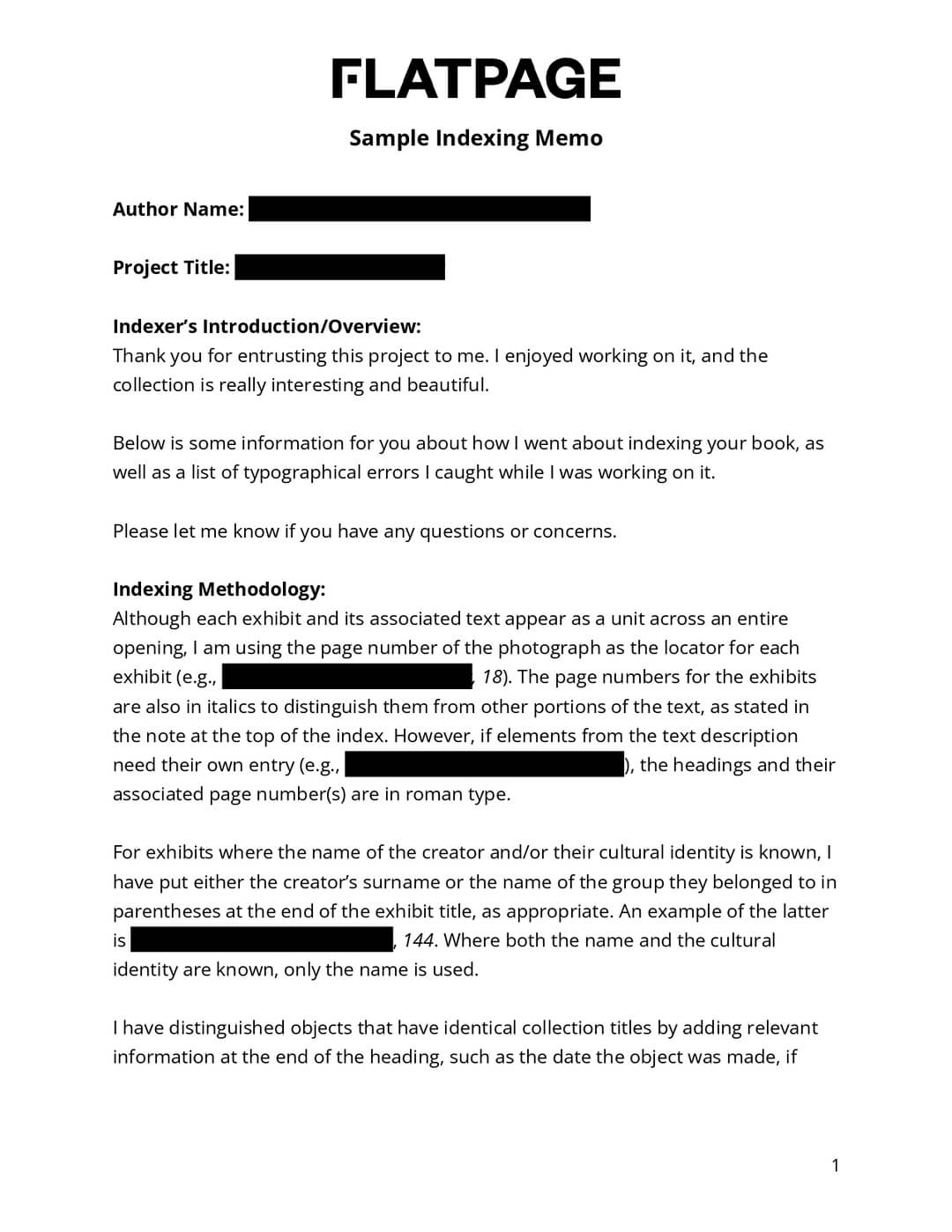
Sample Indexing Memo
All indexes are unique to the publication, and a sample edit is therefore not possible.
See this indexing memo to see the type of feedback the indexer will provide upon completing a project.
Pricing & Turnaround
How Much Does Book Indexing Cost?
The cost of book indexing depends on the page count and complexity of your manuscript, as well as the indexing requirements for the project. The indexable page count includes body text, footnotes or endnotes, illustrations, and appendices, but excludes front matter, back matter, and bibliographies. For current pricing, please see our Editorial Services page or contact us for a quote.
Your final cost is based on the actual number of pages that require indexing rather than the book’s total page count. We’ll confirm the indexable page count with you before work begins so you know exactly what to expect.
How Long Does Book Indexing Take?
Most book indexing projects are completed within 1–4 weeks, depending on the length and complexity of the book. Shorter trade nonfiction books may take about a week, while large academic volumes with extensive footnotes may require the full month.
We’ll confirm a realistic turnaround time at the start of the project so indexing fits into your production schedule.
Editorial Portfolio
Our PortfolioAcademic Book Indexing

Exhibition Catalogue Indexing and Proofreading
Make your book easier to navigate with a professional index built around the concepts, names, and subjects your readers need to find.